How to Choose the Right Knitwear Manufacturer in China: A Buyer's Guide
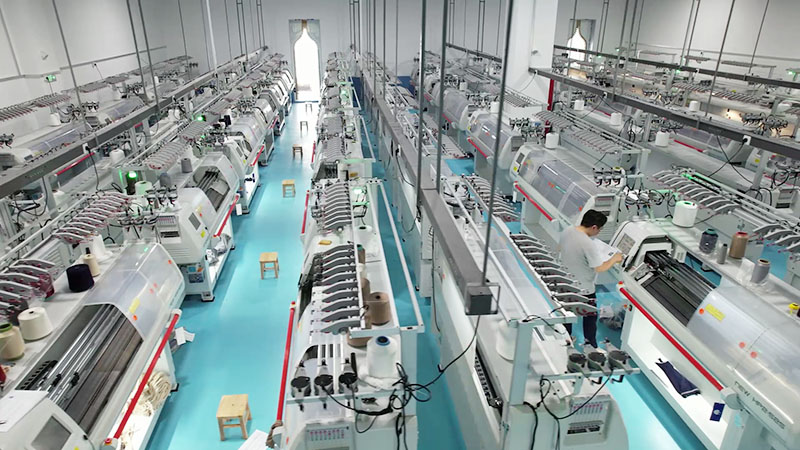
China remains the world's dominant force in knitwear manufacturing, producing billions of pieces annually across clusters in Zhejiang, Guangdong, and Shandong. For international fashion brands, private labels, and wholesalers, the question is rarely whether to source from China — it's how to choose the right manufacturing partner from thousands of available options. Making the wrong choice can mean missed deadlines, inconsistent quality, compliance headaches, and margin erosion. Making the right one unlocks a reliable, scalable, and cost-effective supply chain.
This guide walks through the key factors buyers should evaluate when selecting a knitwear manufacturer in China, drawing on insights from the Honghe cluster — China's largest sweater production zone, home to Jiaxing Sweater City Group and over 200 enterprises.
1. Understand the Cluster Before You Choose a Factory
China's knitwear industry is organized into regional clusters, each with its own specialization. Zhejiang's Honghe-Tongxiang-Puyuan corridor is the heavyweight for sweaters and knitwear across all gauges. Guangdong's Dalang-Dongguan area excels in computerized knitting and fast fashion. Shandong's Haiyang region is known for wool and cashmere.
Choosing the right cluster matters because each comes with its own ecosystem: yarn suppliers, dyeing and finishing services, accessory markets, skilled labor pools, and logistics infrastructure. A factory in a major cluster benefits from these surrounding resources in ways an isolated facility cannot match. When you source from a cluster like Honghe, you are not just buying a factory's capacity — you are buying into 40 years of accumulated know-how, supplier networks, and specialized services.
2. Gauge Range and Technical Capability
Knitwear is not a single product category. A factory that excels at 14GG fine-gauge merino pullovers may struggle with 3GG chunky cable-knit cardigans. Before engaging a manufacturer, confirm their gauge range and verify it against your product requirements. The standard range for full-service manufacturers spans 3GG to 18GG.
Equally important are specialty techniques. If your collection features intarsia patterns, jacquard weaves, embroidery, hand-crochet details, or all-over digital printing, ensure the manufacturer has proven experience — not just equipment — in those techniques. Ask for samples, not promises.
Equipment also tells a story. Look for a mix of German Stoll, Japanese Shima Seiki, and domestic Cixing machines. Stoll excels at complex patterns, Shima Seiki leads in fully-fashioned (whole-garment) knitting, and Cixing provides cost-efficient capacity for standard runs. A balanced equipment portfolio signals both technical depth and operational flexibility.
3. MOQ, Sampling Speed, and Lead Time: The Operational Triad
Three numbers define the practical rhythm of any sourcing relationship:
Minimum Order Quantity (MOQ): Standard MOQs in China's knitwear industry range from 50 to 300 pieces per style, with 100 pieces being the most common baseline. Lower MOQs (50 pcs) are increasingly available from manufacturers targeting emerging designer brands and small-batch buyers — but confirm this early, as it affects yarn procurement and production planning.
Sampling turnaround: 3-5 working days from tech pack confirmation is the industry benchmark. Faster turnarounds (5 days) are possible but typically incur rush fees. A manufacturer that takes more than two weeks for standard samples may struggle with communication or capacity.
Bulk production lead time: 25-45 days is standard, depending on order volume and style complexity. Factor in an additional 5-10 days during peak season (June through September). Smart buyers place orders 2-3 months ahead of their in-store date to absorb any delays.
Ask for these three numbers upfront. A manufacturer that hesitates to commit to specific timelines is a red flag.
4. Certifications: The Compliance Shortcut
Certifications are not just wall decorations — they are pre-verified proof that a factory meets internationally recognized standards. The most relevant certifications for knitwear sourcing include:
OEKO-TEX Standard 100: Certifies that every component of a garment is free from harmful substances. This is the baseline expectation for EU and US markets.
BSCI (Business Social Compliance Initiative): Demonstrates adherence to social responsibility standards, including working conditions, fair wages, and no child labor. Increasingly mandatory for European buyers.
SEDEX / SMETA: Preferred in UK and Australian markets for ethical supply chain auditing.
GRS (Global Recycled Standard): Required if your products use recycled fibers and you want to make that claim.
GOTS (Global Organic Textile Standard): The gold standard for organic fiber certification.
A manufacturer actively pursuing or maintaining these certifications demonstrates both compliance awareness and a willingness to invest in long-term buyer relationships. If a factory has none and shows no interest in obtaining them, proceed with caution.
5. Quality Control: Systems, Not Just Inspections
Every factory claims to have quality control. What distinguishes serious manufacturers is a structured, multi-stage QC system:
Yarn incoming inspection: Composition testing, color shade matching, yarn count verification, and strength testing before knitting begins.
In-line inspection: Checks at critical production stages — knitting density, pattern accuracy, linking strength, washing shrinkage, and ironing finish.
Pre-shipment final inspection: AQL 2.5 random sampling against specification sheets, including measurements, appearance, and packaging.
Ask for a sample QC report. A manufacturer that can produce a detailed, photo-documented report for a previous order is operating with genuine quality systems, not wishful thinking.
6. Communication and Service Infrastructure
Language barriers, time zones, and cultural gaps can erode the efficiency of even the best factory. Evaluate a potential partner on:
English proficiency: Does the sales or merchandising team communicate clearly in written English? Misunderstood tech packs are a leading cause of sampling delays.
Service structure: Is there a dedicated point of contact? Can they provide digital photos for remote approval before shipping samples? Do they offer DDP/DAP shipping terms?
Visit readiness: Is the factory open to buyer visits and third-party audits? A manufacturer that welcomes scrutiny is one confident in its operations.
Honghe's location, approximately 1.5 hours from Shanghai by high-speed train, makes it logistically convenient for international buyers. Factories that proactively offer airport pickup and on-site accommodation are signaling serious interest in partnership.
7. The Platform Advantage: Integrated vs. Fragmented Sourcing
A growing trend in China's knitwear industry is the emergence of state-backed sourcing platforms like Jiaxing Sweater City Group. These platforms address a common pain point: the fragmentation of the traditional sourcing model, where buyers must separately identify, vet, negotiate, and coordinate with multiple factories, yarn suppliers, and logistics providers.
An integrated platform offers a single-window solution: verified suppliers, in-house quality control, design and sampling support, consolidated logistics, and — increasingly — branded collections that simplify product selection. For buyers managing complex, multi-category winter collections, this consolidation can significantly reduce sourcing overhead and risk.
Making the Decision
Choosing a knitwear manufacturer is not about finding the cheapest quote — it's about finding a partner whose capabilities, communication style, and business philosophy align with your brand's needs. Visit the factory if possible. Review QC documentation. Talk to existing clients. And consider the ecosystem around the factory, not just the factory itself.
In an industry where trust is built one order at a time, the right partner is worth the due diligence.